
Search Pasquotank County Court Records
The main online path for Pasquotank County court records is the NC eCourts Portal. The Portal is the statewide public system for Smart Search, hearing search, payments, and judgment search. Pasquotank County moved into eCourts with Track 3, and the Judicial Branch later announced eCourts availability in all one hundred North Carolina counties in 2025. That means the same public Portal now supports local searches for many case records from Pasquotank County Superior Court, Pasquotank County District Court, and clerk-maintained proceedings when the record is public and online.
The Portal is useful for locating case numbers, parties, file dates, court events, hearing dates, balances in payable cases, and some public documents. It is not the only access channel. If the public view does not show the document needed, the Pasquotank County Clerk of Superior Court remains the local record custodian. Jennifer Thompson is the Pasquotank County Clerk of Superior Court, and the clerk's office at the courthouse handles public terminal access, paper file inspection, and copies for local cases.
- Open the NC eCourts Portal and choose Smart Search for case records rather than Search Hearings, which is built for court dates.
- Enter a case number, citation number, party name, business name, attorney name, attorney bar number, cross-reference number, or nickname when that search mode is available.
- Use the location filter to select Pasquotank County so statewide matches from other North Carolina counties do not crowd the result set.
- Open the matching case and review the case type, status, parties, docket events, hearing entries, financial data, and document links that are public.
- When the online record is incomplete, use the public terminal or paper file at the Pasquotank County Clerk of Superior Court for the county where the case is filed.
The Judicial Branch court-records help topic is the official statewide source for how North Carolina court files are accessed. Its guidance matters in Pasquotank County because the local clerk follows the same public terminal, paper file, and copy framework.
The court-records help page confirms that online access and clerk-office access serve different needs, especially when a person needs the full file rather than a search result.
Pasquotank County Court Records Search Fields
Smart Search has a broader field set than a simple name box. A person can start with one record number or one party name, then use advanced filters to narrow the Pasquotank County court records search. The county filter is important because the Portal is statewide. Wildcard rules also matter: the research capture notes that case-number wildcard searches need at least four characters, last-name wildcards need at least three characters plus an asterisk, and first-name wildcards need at least one character plus an asterisk.
| Field Label | Type | Required | Notes / Format |
|---|---|---|---|
| Record Number or Name | Text | One term required | Use a case number or Last, First Middle Suffix format. |
| Last Name / First Name | Text | Conditional | Structured party search; wildcard searches use character minimums and an asterisk. |
| Filter by Location | Multi-select | Recommended | Select Pasquotank County to avoid statewide matches. |
| Search by | Option control | No | Party Name, Nickname, Business Name, and Sounds Like are noted search modes. |
| DOB From / DOB To | Date | No | Advanced party criteria; public display of birth data may be limited. |
| Case Type / Case Status | Dropdown | No | Used to narrow civil, criminal, family, estate, and other case groups when options appear. |
| File Date Start / End | Date | No | Useful when the filing period is known but the case number is not. |
The official obtaining-court-records instructions explain when to use online access, public terminals, and the clerk's paper files. Pasquotank County users should follow that same split when a public document is not visible online.
This source is especially useful for separating online case information from requests for copies of actual documents in a court file.
Types of Pasquotank County Court Records
Pasquotank County court records are created in both Superior Court and District Court. Superior Court handles felonies, higher-value civil cases, many jury matters, and appeals from District Court. District Court handles many misdemeanors, infractions, traffic matters, juvenile matters, domestic cases, small claims, and magistrate-related proceedings. The Clerk of Superior Court keeps records for both trial divisions, so the office is the central county contact even when the case began in District Court.
Civil records can include complaints, summonses, answers, motions, orders, proof of service, judgments, settlements, and dismissals. Criminal records can include citations, criminal summonses, warrants after return, indictments, informations, bond conditions, pleas, motions, judgments, dispositions, sentence entries, probation terms, and financial obligations. Estate and special proceeding files may include wills, applications, letters, inventories, accountings, foreclosure orders, guardianship filings, and clerk-heard matters. Divorce judgments are court records, while marriage licenses and many vital records are handled by the nearby Pasquotank County Register of Deeds.
- Civil court records identify the parties, claims, filings, service events, orders, judgments, and case status.
- Criminal court records track charges as filed, hearings, pleas, motions, dispositions, sentences, and costs.
- Traffic records cover citations, infractions, court dates, waiver eligibility, and outcomes separate from DMV driver records.
- Family and divorce records may show public docket and judgment details, with privacy limits for sensitive material.
- Estate and special proceeding records are clerk-supervised records, often tied to probate, guardianship, foreclosure, and related orders.
What Pasquotank County Court Records Show
A public case record is not the same thing as a full paper file. The public Portal may show case-level information, selected events, hearings, balances, and document links where access is allowed. The full clerk file can hold pleadings, motions, exhibits, orders, signed judgments, and older paper materials that are not part of the public online result. For a legal filing, title search, employment issue, immigration matter, appeal, or other formal use, the clerk's copy is usually more useful than a screen view.
| Field | What It Shows |
|---|---|
| Case number | The primary court identifier used to search, request copies, and match hearings. |
| Location and division | Pasquotank County plus the trial division or case group, such as civil, criminal, family, or probate. |
| Parties | Names such as plaintiff, defendant, petitioner, respondent, state, estate, guardian, or ward. |
| Filing date and status | When the matter was opened and whether it appears pending, closed, disposed, or otherwise marked. |
| Docket events | Filings, notices, motions, continuances, hearings, judgments, orders, and other case activity. |
| Hearings | Date, time, hearing type, location, courtroom, and judicial officer when public and available. |
| Financial obligations | Costs, fines, fees, balances, or payment eligibility in cases that can be paid through Portal tools. |
| Redactions | Removed or hidden personal data, juvenile details, sealed content, and confidential material. |
Search results should be read with care. A criminal charge is not the same as a conviction. A dismissal is not always an expunction. A pending civil claim is not a judgment. Docket entries tell the sequence of events, while the signed order or judgment explains the legal effect.
Pasquotank County Court Records Access Law
North Carolina gives court records their own recordkeeping rule. N.C.G.S. 7A-109 requires clerks to keep records, files, dockets, and indexes, and it makes them open to public inspection during regular office hours unless another law says otherwise. That is the core rule for Pasquotank County court records at the Clerk of Superior Court.
The state public-records law also matters. N.C.G.S. 132-1 defines public records broadly for North Carolina agencies, and N.C.G.S. 132-1.4 addresses criminal investigation records and returned criminal process, including returned warrants and indictments. Juvenile records have separate limits under Chapter 7B Article 30, so juvenile matters should not be treated like ordinary adult case records.
Note: Public inspection rights do not override sealing orders, expunctions, juvenile confidentiality, adoption restrictions, or protected personal identifiers.
The Judicial Branch public-records request page separates court records from police reports, vital records, deed records, and general agency records. That distinction helps Pasquotank County users send requests to the correct office.
The public-records guidance supports a fallback path when Portal access is not enough and the request must go to the clerk or another agency.
Pasquotank County Court Records Channels
Pasquotank County court records can be reached through several official channels. Smart Search is the free public starting point. Search Hearings is the calendar and court-date tool. The clerk's public terminal can search criminal cases by defendant name, case number, or victim/witness name, and it also supports civil, special proceeding, and estate case information. Paper court files are inspected in the county where the case is located, so Pasquotank County case files are handled by the local clerk's office in Elizabeth City.
The Remote Public Access Program is a different service. It is a licensed statewide data program run by NCAOC for approved users who need criminal and civil court data at scale. It is not the same as a free Portal search and should not be presented as a casual lookup tool. The research notes authority in G.S. 7A-109(d), G.S. 7A-109(e), and G.S. 7A-343.2 for RPA functions.
The Remote Public Access program page describes licensed data access for North Carolina court data. Pasquotank County records can be part of that statewide data flow for eligible licensees.
RPA is best understood as a professional access channel, while the Portal and clerk office serve ordinary public record searches.
The RPA online access page gives the current statewide fee and coverage information. Use that source instead of assuming a Pasquotank-only fee schedule.
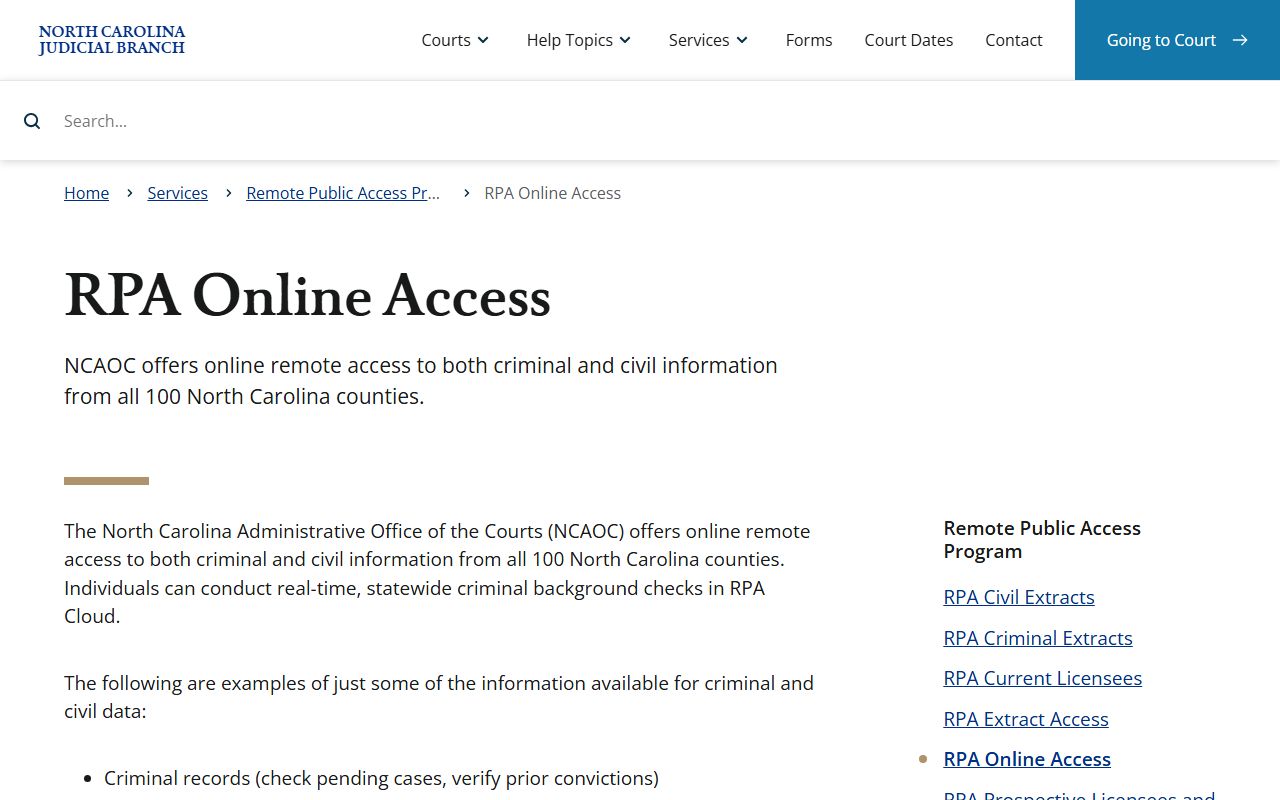
The fee and coverage page is the proper source for licensed data costs because local research did not identify a separate Pasquotank RPA fee.
Restricted Pasquotank County Court Records
Not all Pasquotank County court records are public. Juvenile files are governed by Chapter 7B Article 30 and are not ordinary Portal records. Adoption files are generally confidential. Sealed and expunged criminal records are removed or blocked from ordinary public access. Mental health and incompetency proceedings may appear as a hearing category in court tools, but protected medical, social, and personal content should not be described as open public material.
Expunction has its own process. A dismissed charge does not vanish from public access just because the case ended. A person seeking to clear a North Carolina criminal record must use the correct AOC petition, file in the court where the matter occurred, and meet the statute that applies to that charge or conviction. For Pasquotank County matters, the Clerk of Superior Court is the local filing point, but eligibility questions are legal questions rather than clerk copy requests.
Pasquotank County Clerk Record Requests
In-person access is still important for Pasquotank County court records. The public terminal can help locate case information, and staff can provide copies from court files for a fee. The research did not locate a Pasquotank-only copy fee schedule, so use the current North Carolina Judicial Branch fee schedule or ask the clerk before ordering large copy sets. Bring the case number if known, the party names, the case type, and an approximate filing date.
Pasquotank County Clerk of Superior Court
206 E Main St
Elizabeth City, NC 27909
(252) 331-4600
Courthouse hours: Monday-Friday, 8:30 AM-5:00 PM
Civil email: Pasquotank.Civil@nccourts.org
Criminal email: Pasquotank.Criminal@nccourts.org
For divorce judgments, civil files, criminal background checks, estate files, and certified copies, the clerk's office is the correct local office. For marriage licenses and many vital-record copies, use the Pasquotank County Register of Deeds instead.