
Pasquotank County Criminal Case Files
A criminal court record in Pasquotank County is the case file kept by the Clerk of Superior Court after a citation, warrant, summons, indictment, or other charging paper starts a court matter. The file can include the charges, court events, bond conditions, orders, motions, pleas, judgments, sentence terms, probation details, and financial obligations. The Clerk of Superior Court is the local record custodian for Superior Court and District Court files, while the District Attorney prosecutes the case and law enforcement may hold separate arrest or investigative records.
North Carolina divides trial work between Superior Court and District Court. Pasquotank County Superior Court hears felony criminal cases and appeals from District Court. Pasquotank County District Court handles many misdemeanors, infractions, traffic matters, first appearances, and lower-level criminal proceedings. Magistrates are District Court judicial officers who can be involved in criminal process and initial matters. A charge may start in one setting and later move, especially when a felony proceeds beyond the early stage.
The North Carolina Judicial Branch courts overview places Pasquotank cases in the statewide General Court of Justice. The separate types of courts page explains why Superior Court and District Court records can both appear in a criminal search. That split matters when a person sees a first appearance, probable cause setting, indictment, plea, or sentence in the same case history.
The Judicial Branch courts overview is one assigned source for Pasquotank County criminal court records.
The statewide court structure helps explain why Pasquotank County criminal court records may reference both District Court and Superior Court actions.
Search Pasquotank County Criminal Records
The main online path is the NC eCourts Portal. Smart Search can locate public case information by record number, name, attorney, citation, business name, and other filters. For county-specific results, select Pasquotank County under the location filter. The Portal can also show hearing information, documents when public and online, judgment details, and payment balances for eligible cases. JavaScript and cookies must be enabled, and users may see a CAPTCHA during repeated searching.
- Open the NC eCourts Portal and use Smart Search for the case lookup.
- Enter a case number, citation number, or defendant name in the required format.
- Use the Pasquotank County location filter to reduce statewide name matches.
- Open a matching result and review the docket, charge list, hearings, disposition, and financial details.
- Ask the Clerk of Superior Court for a copy or certified copy when the online view is incomplete or not enough for legal use.
The online Portal is not the only access channel. The Judicial Branch court-records guidance says criminal case information can be searched at a public self-service terminal in any clerk's office by defendant name, case number, or victim or witness name. For the paper file, use the clerk's office in the county where the case is located. For Pasquotank County criminal court records, that local office is at the courthouse in Elizabeth City.
Use the Superior Court overview for felony jurisdiction context.
Felony records often move through Superior Court, while many misdemeanor and infraction matters remain in District Court.
Note: Portal searches are useful for quick lookup, but formal criminal background checks should be requested through the clerk's office.
Pasquotank Criminal Case Flow
A criminal file is built in stages. Early entries may be brief, such as the filed charge, bond, and first appearance. Later entries may show motions, continuances, plea terms, trial results, dismissal orders, judgment, probation, costs, and sentence. The full file can also show that one count was dismissed while another count produced a conviction. That is why the full criminal file is different from a shorter Pasquotank County arrest records and court charges lookup.
Case flow: Charges Filed › First Appearance or Arraignment › Pretrial and Motions › Plea or Trial › Disposition › Sentencing.
| Stage | What the Pasquotank County Record May Show |
|---|---|
| Charges filed | The offense, statute, case number, filing date, charging agency, and court division when public. |
| First appearance or arraignment | Initial court setting, bond review, counsel status, and plea-related events depending on the case type. |
| Pretrial and motions | Continuances, discovery-related filings, suppression motions, orders, and hearing dates. |
| Plea or trial | Plea entry, verdict, dismissal, acquittal, or other result for each charge. |
| Disposition and sentence | Final judgment, sentence, probation, fines, costs, and payment status where public and applicable. |
The Judicial Branch court records help topic is an assigned source for public court-record access rules.
Those court-type rules help a reader place each Pasquotank criminal event in the correct part of the state trial system.
Pasquotank Criminal Record Fields
Portal records and clerk files do not all display the same level of detail. A public online result may show case metadata, events, hearings, public documents, and financial items. A paper file may contain filings or orders that do not appear online. Some records are redacted or unavailable because they involve juveniles, sealed filings, expunctions, protected personal identifiers, mental health content, or other confidential material.
| Field | What It Shows |
|---|---|
| Case number | The court's record number, used to search, request copies, and confirm the correct file. |
| Defendant | The person accused in the criminal case; names may need exact formatting in Portal. |
| Court location | Pasquotank County and the court division handling the event or case. |
| Charges | Offense names, statutes, charge level, offense dates, and charge status when public. |
| Hearings | Date, time, hearing type, courtroom, and judicial officer where the public record shows them. |
| Docket events | Filings, motions, orders, continuances, notices, judgments, and other case activity. |
| Disposition | Outcome for a charge or case, such as dismissed, guilty, not guilty, or judgment entered. |
| Sentence | Jail or prison term, probation, conditions, fines, costs, or other judgment terms when public. |
| Bond | Bond amount, surety, custody condition, or release terms if part of the public court file. |
For documents not shown in Portal, the Pasquotank County Clerk of Superior Court can direct users to paper-file inspection or copy request options. The county clerk page names Jennifer Thompson as Clerk of Superior Court and lists the office at 206 E Main St, Elizabeth City, NC 27909, phone (252) 331-4600. The Judicial Branch courthouse page lists regular courthouse hours as Monday through Friday, 8:30 AM to 5:00 PM.
Pasquotank Charges vs Convictions
A charge is an accusation. A conviction is a court outcome. Pasquotank County criminal court records may show charges that were reduced, amended, dismissed, or resolved by plea. A single case can have several counts with different results. Read the disposition for each count before treating the case as a conviction record. The record may also show a plea to one charge and dismissal of another.
| Point of Comparison | Charge | Conviction |
|---|---|---|
| Meaning | An accusation filed with the court. | A final guilty finding, plea, or judgment. |
| Stage | Early or pending part of the case. | Later case result after plea or trial. |
| Proof level | Based on criminal process and probable cause standards. | Requires proof beyond a reasonable doubt or a guilty plea. |
| Record effect | May remain visible even if dismissed unless sealed or expunged. | May affect sentence, probation, fines, and later criminal-history treatment. |
Disposition terms also need care. Dismissed generally means the charge did not end in a conviction. Not guilty means the defendant was acquitted on that charge. Guilty, responsible, judgment entered, probation, sentence, and financial obligations all point to different results. Prayer for judgment continued and other North Carolina outcomes may need clerk or legal review before use in a formal setting.
Pasquotank Criminal Record Access
North Carolina law supports public access to many adult criminal court records, but access is not unlimited. N.C.G.S. 7A-109 requires clerks to maintain records, dockets, files, and indexes and makes them open to inspection during regular office hours unless another law blocks access. N.C.G.S. 132-1 defines public records for state and local agencies. For criminal process, N.C.G.S. 132-1.4(k) makes returned arrest warrants, search warrants, indictments, criminal summonses, and similar returned papers public court records unless sealed by court order.
Access point: Start online for public case information, then use the clerk's office for terminals, paper files, and certified copies.
Public access rules also explain why a Portal result may not be complete. Juvenile records are handled under separate juvenile statutes. Adoption, mental health, sealed, expunged, and protected personal data may not appear in public search results. A person who needs a court-certified copy should not rely on a screenshot. Certified copies come from the clerk, and the Judicial Branch notes that copies can involve fees.
The Judicial Branch expunction help topic is the assigned source for record clearing information.
Expunction rules are central when a dismissed or resolved Pasquotank County criminal court record no longer appears in ordinary public access.
Pasquotank Sealed and Expunged Records
Sealing and expunction are different. A sealed record is closed from ordinary public inspection by statute or court order. An expunged record is removed from public access after the correct court order is processed. North Carolina has several expunction statutes, and the research identifies N.C.G.S. 15A-145.5 for certain nonviolent misdemeanor and felony convictions. Eligibility depends on the offense, prior record, waiting period, result, and statutory details.
| Point of Comparison | Sealed | Expunged |
|---|---|---|
| Public view | Hidden from ordinary public inspection. | Removed from ordinary public access after the order is processed. |
| How it happens | By court order or specific law. | By petition, statutory review, and expunction order unless automatic relief applies. |
| Common limits | Juvenile, sensitive, sealed warrant, or protected case material. | Eligibility depends on North Carolina expunction statutes and the case outcome. |
| Practical step | Ask the clerk about access limits if a file is not visible. | Use the Judicial Branch expunction topic and the clerk in the county of the case. |
A dismissal does not always clear a public record by itself. The proper petition, AOC form, fee or fee-waiver request, and court order may be required. The Clerk of Superior Court can identify the local file and filing path, but legal advice should come from an attorney or authorized legal resource.
Pasquotank Appeals and Background Checks
Most appeals from Pasquotank County criminal cases move from the trial court to the North Carolina Court of Appeals, with further review by the Supreme Court of North Carolina in limited situations. Appeal entries, notices, orders, and appellate status may appear in the trial file or in separate appellate records. The Court of Appeals overview is useful for understanding that later path.
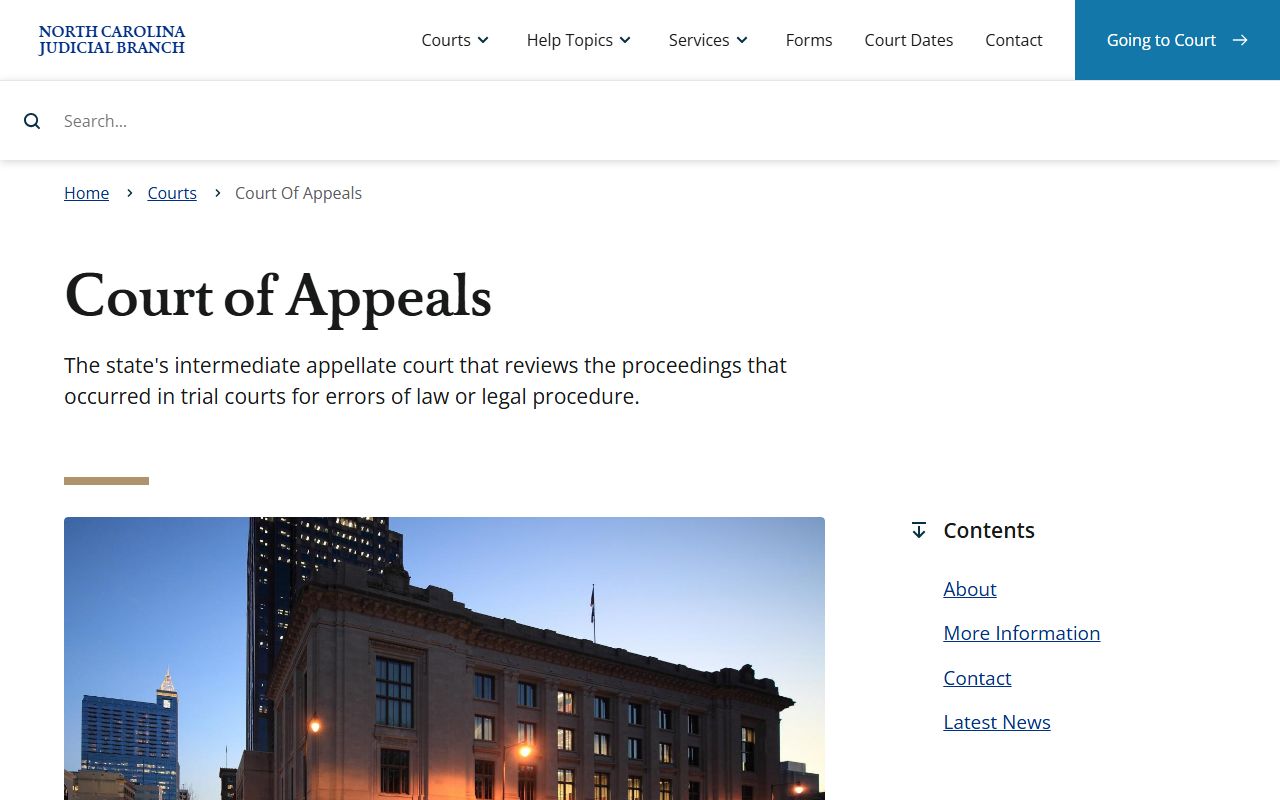
Appeal information can explain why a Pasquotank criminal disposition may not be the final word on a case.
Background checks need a different level of care than casual searching. The Judicial Branch notes that individuals performing background checks should use the county clerk's office rather than relying only on Portal searches. This is especially important for common names, older files, amended charges, sealed cases, expunctions, and cases with mixed charge outcomes.
Important: This private site is not a consumer reporting agency and cannot be used for FCRA-regulated screening decisions.